

Essential Nursing Skills Every Student Should Develop
Nursing education is a journey that combines scientific knowledge, practical competence, professional values, and compassionate care. For a nursing student, academic learning provides the foundation, while regular practice and clinical exposure help transform that knowledge into professional ability.
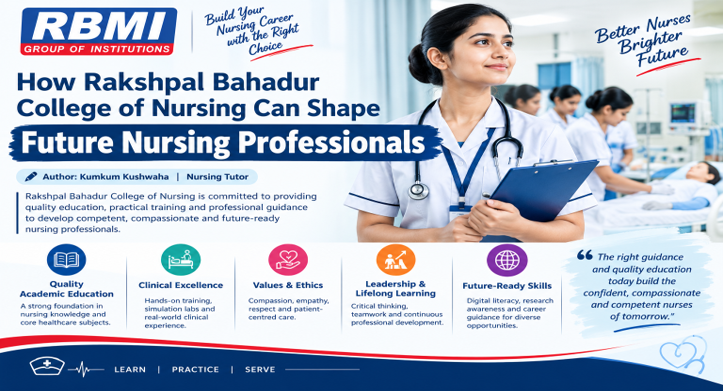
At Rakshpal Bahadur College of Nursing, the learning experience is designed to support students throughout their journey—from understanding fundamental nursing concepts in the first year to developing greater clinical confidence and professional readiness by the final year.
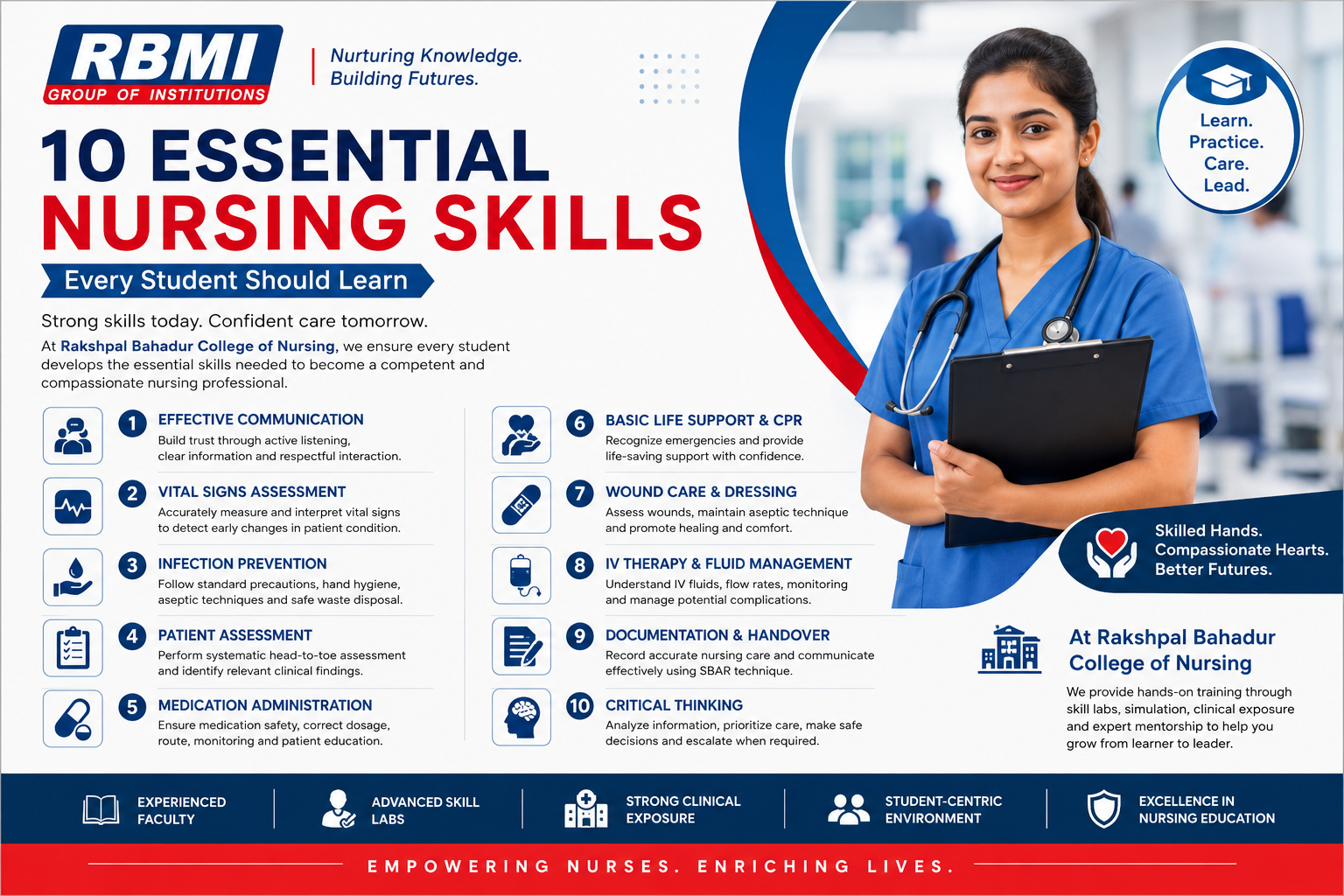
Here are 10 essential skills that every nursing student should work towards developing.
1. Therapeutic Communication
Effective nursing begins with communication. Students learn to listen attentively, communicate respectfully, provide appropriate information, and establish a professional relationship with patients and their families.
2. Vital Signs Monitoring
Accurate assessment of temperature, pulse, respiration, blood pressure, oxygen saturation, and pain helps nurses identify changes in a patient's condition and communicate significant findings promptly.
3. Infection Prevention and Safety
Proper hand hygiene, use of personal protective equipment, aseptic practices, standard precautions, and biomedical waste management are fundamental to maintaining a safe healthcare environment.
4. Comprehensive Patient Assessment
A systematic head-to-toe assessment enables students to collect relevant information, recognize changes in health status, and contribute effectively to individualized nursing care.
5. Medication Safety
Students develop knowledge of medication administration principles, dosage calculations, different routes, potential adverse effects, patient monitoring, and safety checks while practising within their permitted scope and under appropriate supervision.
6. Basic Life Support and Emergency Response
Knowledge of BLS and CPR prepares nursing students to recognize emergencies, initiate an appropriate response, and assist effectively as part of the healthcare team.
7. Wound Care
Learning wound assessment and dressing principles helps students understand infection prevention, aseptic technique, patient comfort, healing assessment, and accurate documentation.
8. IV Therapy and Fluid Management
Understanding IV fluids, fluid balance, flow rates, IV-site monitoring, and potential complications provides an important foundation for safe clinical practice.
9. Clinical Documentation and Handover
Professional nurses must communicate patient information accurately. Students learn the importance of timely documentation and structured handover approaches such as SBAR—Situation, Background, Assessment and Recommendation.
10. Critical Thinking and Clinical Judgement
Beyond performing procedures, nursing requires the ability to observe, interpret information, identify priorities, recognize warning signs, and escalate concerns appropriately. These abilities develop progressively through education, simulation, supervised practice, and clinical experience.
From Learning to Professional Practice
At Rakshpal Bahadur College of Nursing, students are encouraged to strengthen these competencies through skill-laboratory practice, demonstrations, simulation-based learning, case discussions, supervised clinical exposure, and continuous faculty guidance.
As students progress from the first year to final year, the emphasis gradually moves from building strong fundamentals to applying knowledge, improving clinical judgement, strengthening communication, and developing professional responsibility.
The objective of nursing education is not simply to know how to perform a procedure, but also to understand why it is required, how it should be performed safely, and how it contributes to better patient care.