


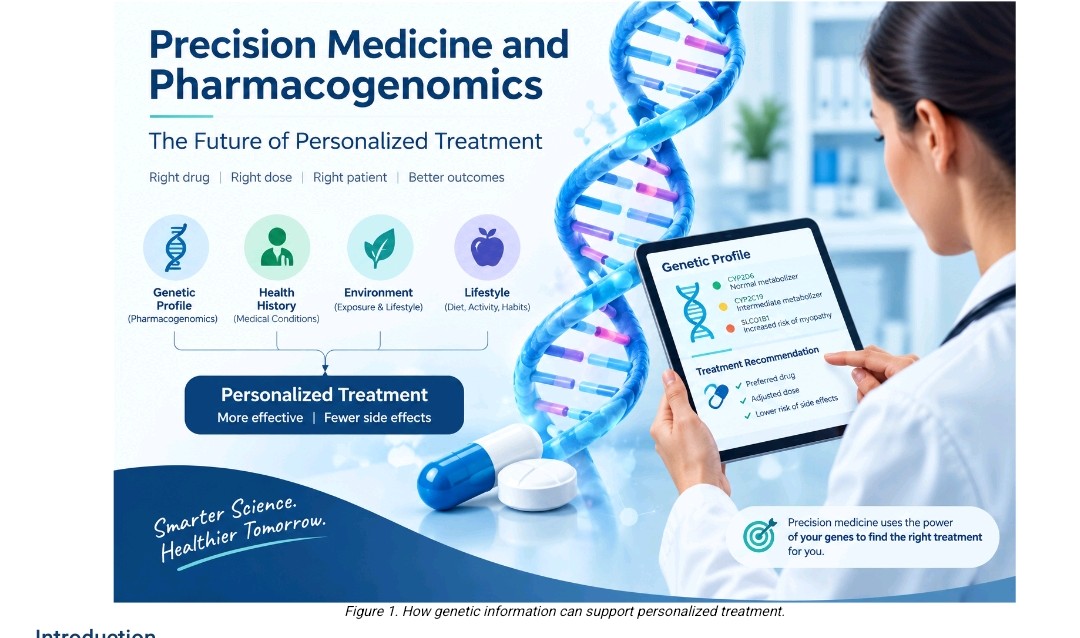
Precision Medicine and Pharmacogenomics: The Future of Personalized Treatment
Introduction
Medicines do not affect every person in exactly the same way. A treatment that works well for one patient may be less effective or cause side effects in another. Genes, age, health conditions, lifestyle, and other medicines can influence treatment response. Precision medicine uses individual differences to help healthcare professionals choose suitable prevention and treatment strategies.
What Is Precision Medicine?
Precision medicine considers a person’s genetic information, environment, lifestyle, and medical history. Instead of relying only on a one-size-fits-all approach, it helps identify treatments that may work best for particular patients or groups. In cancer care, for example, molecular tests can help guide the selection of certain targeted treatments.
What Is Pharmacogenomics?
Pharmacogenomics is part of precision medicine. It studies how genes can affect a person’s response to medicines. Genetic variations may influence how a drug is absorbed, broken down, or interacts with its target. For selected medicines, this information may help a healthcare professional choose a medicine or dose that improves effectiveness and reduces side-effect risks.
How Does Pharmacogenomic Testing Work?
1. Sample collection: blood, saliva, or a cheek swab may be used.
2. Genetic analysis: a laboratory checks for specific variations relevant to certain medicines.
3. Clinical interpretation: a healthcare professional reviews results alongside the patient’s condition, other medicines, and medical history.
4. Treatment decision: where evidence supports it, results may help guide medicine selection or dosing.
Benefits of Precision Medicine
· More informed medicine selection: Genetic information can help identify medicines more likely to work for some patients.
· Safer treatment: For certain gene–medicine pairs, testing can identify increased risk of side effects.
· Individualized dosing: In some cases, genetic differences can inform dose selection or an alternative medicine.
· Advances in cancer care: Molecular testing can help match selected patients to treatments aimed at specific tumour features.
Challenges and Limitations
Precision medicine does not guarantee a perfect treatment. Genetic tests are useful when reliable evidence connects a result to a meaningful treatment decision. Not every medicine has an established test, and results require careful interpretation. Testing may be costly or unavailable in some settings. Protecting genetic privacy and improving access for diverse populations are also important.
Role of Pharmacists
Pharmacists can explain pharmacogenomic results, review possible medicine-related risks and interactions, and support communication between patients and prescribers. They should use reliable clinical guidance and work within their professional scope. Patients should not change or stop medicines based only on a genetic test or online information; decisions should involve a qualified healthcare professional.
Conclusion
Precision medicine and pharmacogenomics are helping healthcare move toward more individualized treatment. By combining genetic information with health history, environment, and lifestyle, healthcare professionals may make better-informed decisions for selected medicines and conditions. Continued research, responsible data use, and teamwork among doctors, pharmacists, and laboratories can help this field develop.