

Unlocking the Career Opportunities in CROs at RBMI Bareilly
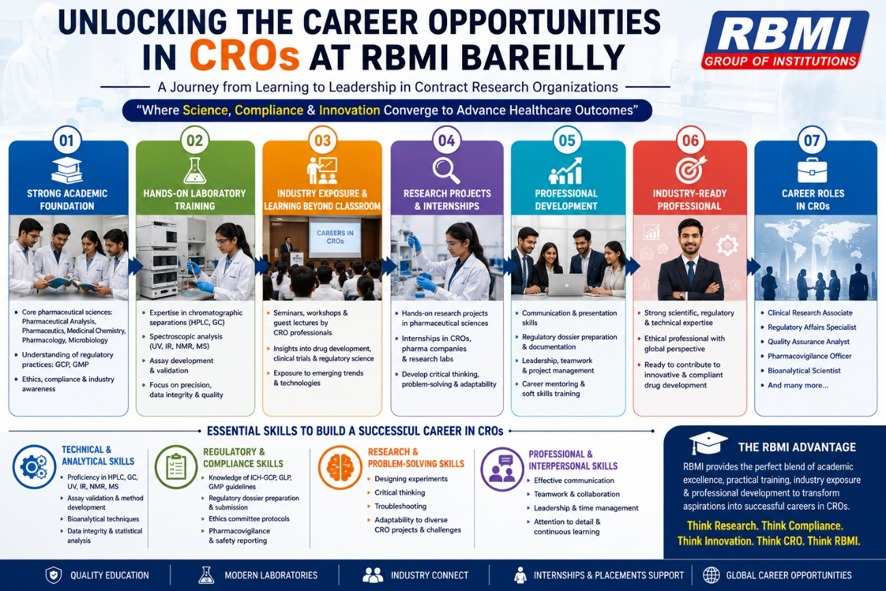
The career roadmap for Contract Research Organization (CRO) careers at RBMI is envisioned as a comprehensive journey that transforms students into industry-ready professionals through a carefully structured progression. It begins with a strong academic foundation in pharmaceutical sciences, where students immerse themselves in disciplines such as pharmaceutical analysis, pharmaceutics, medicinal chemistry, pharmacology, and microbiology. This academic grounding is enriched by exposure to regulatory practices like Good Clinical Practice (GCP) and Good Manufacturing Practice (GMP), ensuring that students understand the ethical and compliance frameworks essential to the pharmaceutical industry. Building upon this knowledge, students engage in hands-on laboratory training that develops technical expertise in chromatographic separations, spectroscopic analysis, and assay validation, fostering precision, data integrity, and analytical confidence. Industry exposure is seamlessly integrated through seminars, workshops, and guest lectures by CRO professionals, which connect theoretical learning with real-world applications and highlight emerging trends in drug development, clinical trials, and regulatory science. As students advance, they participate in research projects and internships that provide practical experience, encouraging critical thinking, problem-solving, and adaptability in diverse CRO roles. Professional development initiatives further refine their communication skills, regulatory dossier preparation, leadership abilities, and teamwork, equipping them to excel in collaborative and multidisciplinary environments. By the conclusion of this roadmap, graduates are prepared to step into specialized roles such as Clinical Research Associate, Regulatory Affairs Specialist, Quality Assurance Analyst, Pharmacovigilance Officer, and Bioanalytical Scientist. To build a career in Contract Research Organizations (CROs), a combination of scientific knowledge, regulatory awareness, technical expertise, and professional skills is essential. They need strong technical and analytical skills such as proficiency in chromatographic techniques (HPLC, GC), spectroscopic methods (UV, IR, NMR, Mass Spectrometry), assay validation, and bioanalytical method development, along with the ability to maintain data integrity and perform statistical analysis. Equally important are regulatory and compliance skills, including knowledge of ICH-GCP, GLP, and GMP guidelines, preparation of regulatory dossiers, understanding of ethics committee protocols, and pharmacovigilance reporting. Students must also develop research and problem-solving skills like designing experiments, critical thinking, troubleshooting, and adaptability to diverse CRO projects.Ultimately, this structured pathway ensures that RBMI students are not only academically proficient but also globally competitive, ready to contribute meaningfully to the CRO industry where science, compliance, and innovation converge to advance healthcare outcomes.