

Build your Personal Idea Lab
Build your Personal Idea Lab: A Student's Guide to Business Innovation
Have you ever had a "million-dollar idea" in your mind, only to forget it by the time you engage with other daily tasks? In management terms, ideas are the primary currency. However, most of us treat our ideas like loose money—dropping them into random notebooks or leaving them to fade in memory.
In the era of digital transformation, managing innovations through digital tools is not optional—it is a core management competency. Your Personal Idea Lab is the first step toward mastering this tech-driven business landscape. MBA colleges in UP should take a lead towards idea incubation, as the government is also focusing on the same.
To succeed in the 2026 business landscape, you need a system to capture and transform your idea into a business venture. Just like internships, your Idea Lab provides the strategic playground to test what you've learned.
So, welcome to the concept of Personal Idea Lab: a dedicated, structured environment where raw concepts are nurtured into viable business innovations, helping management students use tools like Power BI, Notion, etc.
What is Personal Idea Lab?
A Personal Idea Lab is a structured, business-oriented environment where students can make use of systematic tools to capture, refine, and validate raw concepts. It utilizes incubation frameworks like market feasibility analysis and rapid prototyping to transform academic theories into viable business innovations.
Developing both Entrepreneurial and Intrapreneurial Value
Apart from Entrepreneurial prospects, an Idea Lab also helps build "Intrapreneurial Value." Candidates can demonstrate to their employer that they have a systematic way of thinking and innovating, building themselves into a standout candidate for leadership roles or promotions.
Tools of Trade: Equipping Your Idea Lab
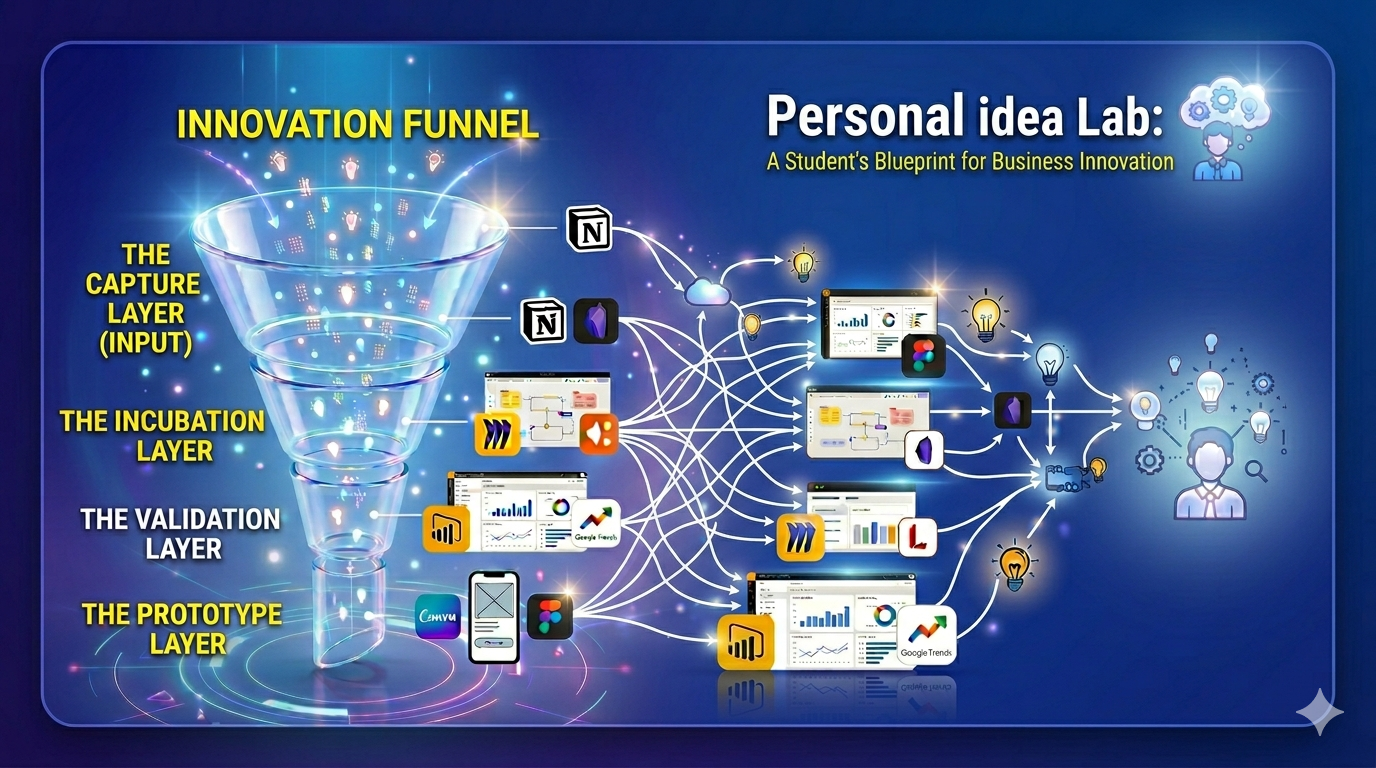
Building a lab doesn't require physical space or a massive budget. Presently, the most effective labs are using a combination of diverse digital tools to move an idea through the "Innovation Funnel."
1. The Capture Layer (Input)
Building an Idea Lab isn't a one-time event; it follows an Agile methodology. Your lab needs a storehouse to catch ideas the moment they happen.
• Tool Required
a) Notion (notion.so) - All-in-one workspace for notes and project management.
b) Obsidian (obsidian.md) - A powerful, private knowledge base that works like a second brain.
• The Business Use—Use these for "Atomic Note-taking." Instead of long paragraphs, capture one single business observation or market gap per note.
• Pro Tip—Tag your notes by industry (e.g., #FinTech, #EdTech) to see patterns emerge over time.
2. The Incubation Layer (Development)
Once an idea is caught, it needs an "innovation sandbox" to grow. This is a safe place to play with ideas, take risks, and test things without consequences. Here you can also apply management frameworks.
• Tool Required
a) Miro (miro.com) - Visual workspace for innovation and digital whiteboarding.
b) Lucidchart (lucidchart.com)—intelligent diagramming application for business process mapping.
• The Business Use—Use these digital whiteboards to build canvases or journey maps. Viewing your idea visually helps identify "pain points" that a simple text document might miss.
3. The Validation Layer (Data Stress-Test)
A business innovation is only considered reliable when it is backed by data facts. This is where you separate "good ideas" from "profitable ones." Instead of becoming over-ambitious with their idea, students can go for market validation.
• Tool Required
a) Power BI (powerbi.microsoft.com) - Microsoft’s data visualization and business analytics tool.
b) Google Trends (trends.google.com) - Analyze the popularity of search queries across Google.
• The Business Use - Before spending on a prototype, use Google Trends to see the demand for your concept. Use Power BI to visualize publicly available industry reports to find new opportunities.
4. The Prototype Layer (Output)
The final stage of the lab is to build the model, where the student’s personal brand begins to shine through professional design.
• Tool Required
a) Canva (canva.com)—Graphic design platform for creating social media graphics and presentations.
b) Figma (figma.com)—Collaborative interface design tool for creating app and web mockups.
• The Business Use - Create a "Visual Pitch," showing a professional-looking design of your idea.
Conclusion (From Thinking to Thriving)
The difference between a “student with a good idea" and a “future business leader” is execution. By systematizing how you capture and nurture innovation, you are building the intrapreneurial mindset that modern companies require.
Remember, your lab doesn't have to be perfect on Day 1. Start by capturing one observation today. Refine it tomorrow. Validate it next week.
For best MBA colleges, the goal should be to emphasize that innovation is a habit, not a lightning bolt.
Madhukar Saxena
Department of Management & Commerce,
RBMI Group of Institutions