

Artificial Intelligence vs Human Intelligence
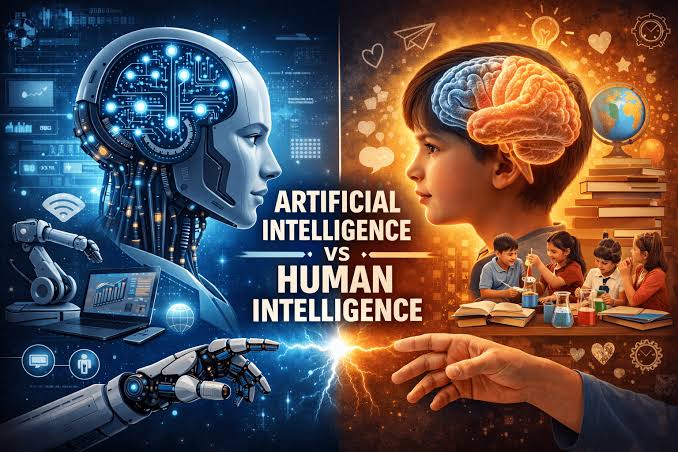
Artificial Intelligence vs Human Intelligence: When Machines Expand the Boundaries of Human Thought
“यदि आप किसी AI को कोई लक्ष्य देते हैं, तो हो सकता है कि वह आपको कुछ ऐसे विचार दे दे, जिनके बारे में आपने कभी सोचा भी न हो।”
“If you give an AI a goal, it may give you ideas that you had never even thought of.”
Artificial Intelligence (AI) is no longer merely a tool for performing tasks quickly. It is increasingly becoming a partner in human thinking, capable of exploring possibilities, identifying unexpected connections, challenging assumptions, and suggesting ideas beyond conventional patterns of thought. The important question is therefore not whether AI will replace human intelligence, but whether it can expand what human intelligence can achieve.
Humans usually define the purpose or goal, while AI can explore a much wider range of possibilities. A scientist may ask AI to solve a complex problem, an engineer to optimize a design, an entrepreneur to identify opportunities, or a student to understand a difficult concept differently. In each case, AI can generate alternative approaches that a person may not have considered.
The greatest value of AI may not always be its ability to provide the correct answer. Its deeper contribution is its capacity to introduce a different question, perspective, connection, or possibility. An architect may discover an unconventional structure; a scientist may identify an unexpected pattern in data; or an entrepreneur may find a new business model by combining unrelated trends. In such situations, AI does not simply provide answers—it expands the space of possible answers.
However, generating possibilities is different from determining which possibilities are valuable. AI may produce numerous ideas, but humans must decide which are practical, ethical, safe, and beneficial. Human intelligence contributes curiosity, purpose, judgment, values, creativity, and responsibility, while AI contributes speed, computational scale, pattern recognition, and extensive exploration.
There is also a danger of blind dependence. If students use AI for every answer without thinking independently, or professionals accept AI recommendations without questioning them, human judgment and creativity may weaken. Therefore, the goal should be to think with AI, not instead of thinking.
The future, therefore, should not be understood as Artificial Intelligence versus Human Intelligence. It should be viewed as a partnership: Human Vision + AI Exploration + Human Judgment. Humans establish goals, AI explores possibilities, and humans evaluate and decide.
Ultimately, AI can expand the horizon of what is possible, but human beings must remain responsible for choosing the direction. The greatest achievement of AI may not be creating machines that think like humans, but creating tools that help humans think beyond themselves.
Artificial Intelligence + Human Intelligence = Expanded Human Potential.