AI Applications in Scientific Discovery: In The Field of Chemistry
What if scientists could discover new chemical compounds without testing thousands of possibilities manually? What if a computer could predict a chemical reaction, identify a potential drug molecule or design an advanced material before it is even synthesised in a laboratory?
Welcome to the new era of Chemistry, where Artificial Intelligence (AI) is transforming scientific discovery.
Traditionally, chemical research depended on laboratory experiments, theoretical calculations, repeated observations and extensive data analysis. Although these approaches remain fundamental, AI is enabling researchers to explore complex chemical problems with greater speed, efficiency and precision.
How Is AI Revolutionising Chemical Discovery?
AI is no longer limited to theoretical discussions. It is becoming an important research assistant across different branches of Chemistry.
- 1. Drug Discovery and Pharmaceutical Research: AI helps identify potential drug candidates, predict molecular interactions and accelerate the development of new medicines.
- 2. Molecular Structure Prediction: Machine learning algorithms assist in understanding molecular properties, chemical bonding and three-dimensional molecular structures.
- 3. Chemical Reaction Prediction: AI models can predict possible reaction pathways, identify suitable reactants and suggest optimal experimental conditions.
- 4. Green Chemistry and Sustainability: AI supports the development of environmentally friendly chemical processes, reduces chemical waste and helps identify sustainable alternatives.
- 5. Advanced Material Discovery: Researchers use AI to explore new polymers, nanomaterials, catalysts, semiconductors and energy-storage materials.
- 6. Spectroscopic Data Analysis: AI assists in interpreting complex IR, NMR, UV-Visible and mass spectroscopy data, helping researchers identify chemical structures and functional groups.
- 7. Computational Chemistry: AI-powered models support molecular simulations, property prediction and the exploration of complex chemical systems.
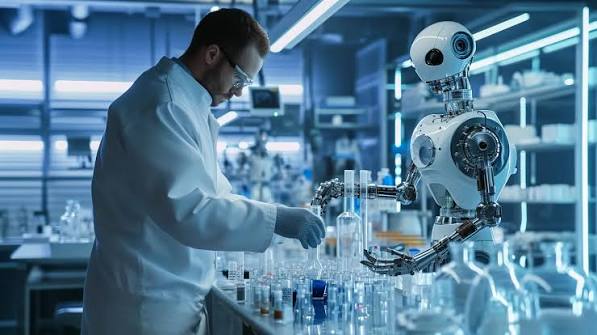
- 8. Smart Laboratories: Intelligent instruments and robotic systems automate repetitive experiments, monitor reactions and improve laboratory efficiency.
Important AI Tools Supporting Chemical Research
Modern researchers and students can explore several digital platforms:
- AlphaFold: Predicts protein structures, supporting biochemical and pharmaceutical research.
- RDKit: Supports molecular modelling and cheminformatics.
- DeepChem: Provides machine learning tools for chemical and molecular research.
- PubChem: Offers extensive chemical structures and property information.
- ChemDraw: Helps visualise molecular structures and chemical reactions.
- Gaussian: Supports computational chemistry and molecular calculations.
Opportunities and Challenges
AI offers faster analysis, improved predictions, reduced research costs and new opportunities for interdisciplinary discoveries. However, researchers must carefully address data quality, algorithmic bias, research ethics and experimental validation.
AI predictions are not scientific proof. Every important finding must be verified through reliable scientific methods and laboratory experiments.
The Future of Chemistry
The future of chemical research will emerge from the collaboration of human intelligence, experimental science and artificial intelligence. Chemistry students must therefore develop strong conceptual knowledge, computational skills, analytical thinking and AI literacy.
Remember: AI can predict what chemistry might discover, but human curiosity and scientific experimentation turn predictions into discoveries.
Think Chemistry. Explore AI. Discover Beyond Possibilities.